

macrofireside.com · August 2, 2026
Part 2 of a two-part series covering the Token revolution in finance and its implications.
Part 1 asked whether the tokenized stock is dangerous. This part asks whom it is dangerous to. Put the reference on a ledger that settles in an instant and never closes, and the venues, clearinghouses, and margin franchises built on the old ledger begin to look optional. The catch is that the incumbents are building the new rails themselves, so the machinery changes hands less than it first appears.
The seam is the business
Part 1 settled what the token is: an old instrument in new clothes, a reference made transferable. This part takes up what it does. Put that transferable reference on a ledger that settles in an instant and never closes. The exchanges, clearinghouses, and margin desks built on the old ledger then begin to look optional. The question stops being whether the token is dangerous and becomes whom it is dangerous to.
Start with how the old structure earns its keep, because that is what is under threat. Today’s market makes its money on the seams. Each product trades on its own venue, clears through its own house, and posts margin into its own silo, and the trade that prints today settles tomorrow. The rents live in those gaps: the bid-offer a market maker keeps, the fee a clearinghouse charges to stand in the middle, the float a custodian earns on cash in transit, the license an exchange sells on its own price data, and the day of settlement risk that justifies a margin balance sitting idle. Fragmentation is what the incumbents get paid to bridge. Every seam is a toll booth.
What the ledger dissolves
A shared ledger closes these seams one by one. Atomic settlement collapses the day between trade and delivery, and with it the fails, the float, and part of the reason margin sits idle. Unified on-chain collateral lets one pledged asset move where it is needed instead of being trapped in a silo behind a cutoff time. Round-the-clock settlement erases the exchanges’ monopoly on the hours the market is open. Programmable contracts do the reconciliation that armies of people do now. When a seam closes, the rent that lived in it closes with it. That is the disruption, and it reaches the process long before it reaches any firm.
The clearest case is collateral, and it is already running. On July 15 the DTCC ran live production trades of tokenized assets, and the transaction that mattered was not a trade at all. JPMorgan posted a tokenized fund to meet a margin call at CME, the largest derivatives exchange in the world, and it settled on-chain inside the DTCC’s own environment. Extend the idea and a tokenized money-market fund can stay yield-bearing while it sits as posted margin, which collapses the old wall between a firm’s collateral pool and its yield book. A Treasury pledged at one venue can be released and redeployed to another in minutes rather than a day. The DTCC has a dedicated collateral platform built with Chainlink arriving later this year to run exactly this around the clock. Industry estimates put roughly a quarter of the average firm’s collateral as effectively stranded by today’s cutoffs and frictions. That stranded quarter is the prize, and it is also somebody’s current revenue.
Three fronts already live
The attack is arriving on three fronts, and all three are live. The first is the event market, which has quietly become a distribution layer for retail derivatives. Kalshi and Polymarket have run tens of billions of dollars through their venues this year, pulled a valuation into the tens of billions, and taken an investment of some two and a half billion dollars from the parent of the New York Stock Exchange. The blow that should worry the incumbents is not the sports book but a finding from the Federal Reserve’s own staff, that prediction-market prices forecast rate moves as well as fed funds futures, the contract the entire CME rates complex is built around. When the upstart prices the Fed as well as the franchise does, the franchise’s information monopoly is the thing that breaks.
It is also where the whole experiment is being fought hardest, because roughly nine in ten of those dollars are sports, and a sports bet is something the states have always policed. The war went off this week. After Kalshi exhausted its federal appeals, with the Second Circuit refusing it relief at the end of July, New York sued for at least thirty-six billion dollars and moved to shut the platform down as an unlicensed casino, and within hours the CFTC sued New York to stop it, one arm of government in state court and another in federal court on the same day. Forty-four state attorneys general have told the CFTC that it has no business regulating what they call gambling, a bipartisan bill in Congress would ban sports contracts outright, and the courts are split, with a federal appeals court siding with Kalshi while state judges from Washington to Nevada to Michigan have blocked it. The question underneath is the one this series keeps returning to: is an event contract a swap, which is federal, or a bet, which is not? A supermajority of states and, in time, the Supreme Court will settle it, and a great deal of capital is riding on the answer.
The second front is the perpetual future, and it is the direct one. A perp is a leveraged futures contract with no expiry, the native instrument of the offshore crypto venues, and until this spring no US-regulated exchange offered one. In late May, the CFTC approved Kalshi’s Bitcoin perpetual on a single day’s self-certification and invited every other contract market to follow. The contract crossed a billion dollars in days. CME answered with a lawsuit rather than a product. In June it sued the CFTC, arguing that a perp is a swap rather than a future, and noting that the agency itself had called perps swaps in five prior enforcement actions. The label is worth real money. A swap posts several days of margin where a future posts one, reports through a heavier regime, and loses the favorable futures tax treatment, so a swap ruling would put more than twice the collateral behind every position and, most likely, push the product back offshore. The oldest name in US derivatives is asking a court to make the new instrument settle through the old plumbing, and its shares fell roughly a tenth on the prospect that the court might say no.
The third front is the quietest and reaches furthest. It is Part 1 seen from the settlement side. Put a tokenized share on one side of a trade and a tokenized dollar on the other, and the two can change hands simultaneously, with no day in between and no house between them to guarantee that they will. Stablecoins now have a statute, tokenized shares have a taxonomy, and the settlement layer that the clearing system exists to protect is precisely the layer a shared ledger automates. This is the front with the least drama and the largest franchise in its path.
The hedges are the tell
Watch what the incumbents are doing rather than what they are saying, because the hedges map the threat exactly. Intercontinental Exchange bought the disruptor, taking a stake worth close to two and a half billion dollars in Polymarket and signing on as its tokenization partner. CME is fighting on one front and joining on another: suing the CFTC over perps while launching its own event contracts through a betting partner and building a securities clearing house to keep the margin offsets in-house. The DTCC and Nasdaq are laying the tokenized rails themselves, a settlement service going live in October and a venue already cleared to trade tokenized index names and moving to trade them around the clock. Cboe is dabbling at the edge, listing event contracts only on financial indices where no state gaming regulator will chase it. Each is hedging the same shift from a different starting point.
One word runs under all of it. The SEC treats a synthetic tokenized share as a security-based swap. The CFTC calls a sports event contract a swap beyond the reach of state gambling law. CME says a perpetual future is a swap that belongs on its own rails. The label is not a technicality. It decides which venue an instrument clears through, how much margin it posts, and who collects the fee for standing between the parties. The fight over what to call these things is a fight over who gets to be the plumbing. It is why the incumbent now wants the swap label it once resisted: a swap routes through the plumbing it already owns.
Who owns the machine afterward
It is the turn the easy version of this story misses, the version that cheers the challengers and shorts the challenged. The record is subtler. The tokenized rails are not being built out on some permissionless frontier beyond the reach of the old institutions. They are being built inside a permissioned perimeter the old institutions own. JPMorgan’s margin token settled on the DTCC’s private chain, with Citadel Securities, BlackRock, Circle, and CME in the room. The DTCC describes the whole effort as leveraging the same market infrastructure investors have relied on for decades. The clearing license, the balance sheet that backs a guarantee fund, the exclusive benchmark, the regulatory relationship: none of those tokenize away. They are the moat, and the moat is being dug deeper on the new rails, not filled in.
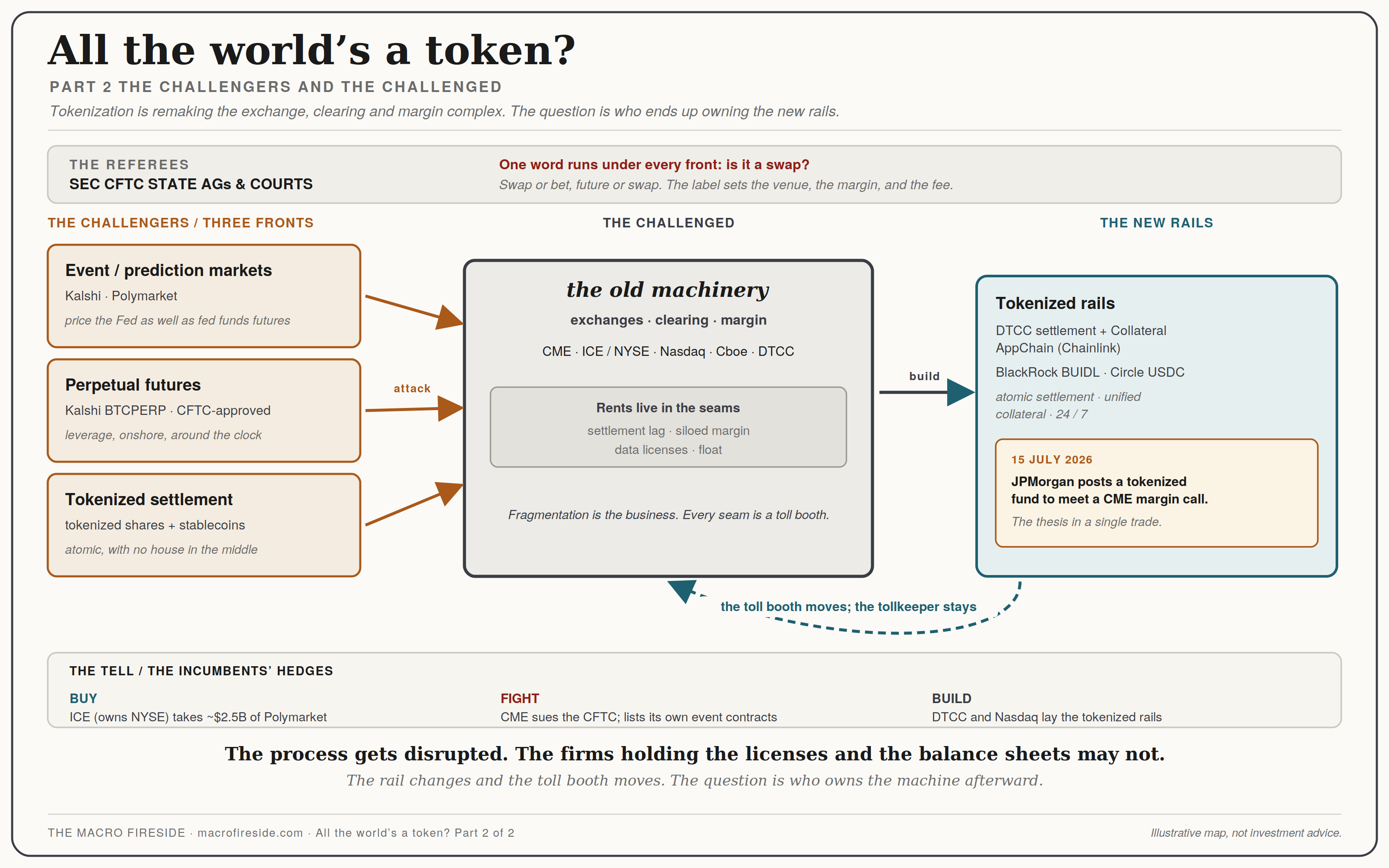
So the honest forecast is a split one. Process disruption is close to certain: the settlement day, the siloed margin, the reconciliation desk, the float, and some of the data rents will thin or vanish, and the firms whose earnings lean hardest on those seams will feel it. Whether the firms themselves are disrupted is far less certain, because the ones holding the licenses and the balance sheets are the ones laying the new track. The rail changes and the toll booth moves, but the tollkeeper tends to stay, under a new name, in the same spot between the two sides. It has happened in other industries too, from enterprise software absorbing agentic AI to legacy automakers building their own electric vehicles. The interesting question for an allocator, or a portfolio manager like me, was never whether the old machinery gets disrupted. It is who owns the machine on the other side.
What it means for the book
For the book this argues against the obvious trade. Shorting the exchange operators as disruption victims mistakes the process for the franchise. The cleaner expression separates the rents that dissolve from the firms that redeploy. Settlement-lag float, idle margin, and a slice of the data revenue are the exposed lines. What sits behind them is sturdier and harder to route around: the clearing franchise, the guarantee fund, the benchmark book, the balance sheet. The same operator usually owns both sides. CME versus the CFTC is the bellwether, because a swap classification for perps decides whether the new leverage routes through the incumbent or around it, and the read runs well beyond one contract.
The same classification question prices the challengers, from the other side. Kalshi’s value rests almost entirely on the premise that its federal license preempts the states, and roughly nine-tenths of its volume is sports. If preemption loses at the circuit level, the business does not step down gracefully into a state-licensed book; it comes apart. That is a binary, and it is close to the mirror image of the one the CME suit poses. A single classification question, pointed one way at CME and the other at Kalshi, helps set the value of both.
Two second-order reads are worth holding. If collateral moves to a 24/7 pool and a yield-bearing token can serve as margin, then the front-end changes shape, and money-market balances, repo, and the value of settlement-day float are all repriced by a system that no longer waits overnight. And the event venues, whatever one makes of them, are now a live probability feed. A liquid contract on a rate decision or a CPI print is a market-implied odds you can lean on or fade, with the standing caution that a thin book moves on small flow.
Part 1 said the token is old wine in a new bottle, and it is. Part 2 is about the bottle. The new container settles in an instant and carries its own title, and that is what dissolves the cellar the old wine was stored and taxed in. Regulate the risk, let the rail compete, and keep an eye on the part that matters for the book: not whether the machinery changes, because it already has, but who is left owning the machine when it does.
Disclaimer
The Macro Fireside is published for informational and educational purposes only. Nothing in this publication constitutes investment advice, a solicitation, or an offer to buy or sell any security, financial instrument, or investment product of any kind. The views expressed are solely those of the author and do not represent the views of any employer, affiliated entity, or counterparty.
All analysis reflects the author’s independent judgment as of the date of publication. Market conditions, data, and regulatory environments change rapidly; no representation is made that any information herein remains current or accurate after the publication date. Past performance of any asset class, strategy, or instrument referenced herein is not indicative of future results.
Readers should conduct their own independent research and due diligence, and consult a qualified financial adviser, attorney, or tax professional before making any investment decision. The author may hold positions in securities or instruments discussed in this publication. Such holdings are subject to change at any time without notice and without obligation to update this publication.
This publication is not directed at, and should not be relied upon by, any person in any jurisdiction where its distribution or use would be contrary to applicable law or regulation. By reading this publication, you acknowledge and agree that the author and The Macro Fireside bear no liability for any investment decisions made in reliance on its contents.
Sources & References
U.S. Securities and Exchange Commission and Commodity Futures Trading Commission, joint guidance.
Commodity Futures Trading Commission, orders and policy statements on perpetual futures and event contracts.
CME Group Inc.; Intercontinental Exchange, Inc.; Nasdaq, Inc.; Cboe Global Markets, Inc.
The Depository Trust and Clearing Corporation (DTCC).
Board of Governors of the Federal Reserve System, staff research.
Kalshi and Polymarket, company disclosures and court filings.
State attorneys general and gaming regulators; federal and state court dockets.
Chainlink, Circle, JPMorganChase, and BlackRock.
Bloomberg and Reuters.