

Series Introduction
This is the first installment in a four-part series examining the dollar’s trajectory and its implications for portfolio positioning. Over the coming weeks, I’ll walk through:
• Part 1 (this piece): The structural catalysts driving dollar weakness
• Part 2: Cross-asset implications - how to think about equities, credit, rates, FX, and commodities
• Part 3: Macro feedback loops and specific market opportunities
• Part 4: What could invalidate this thesis and how to manage that risk
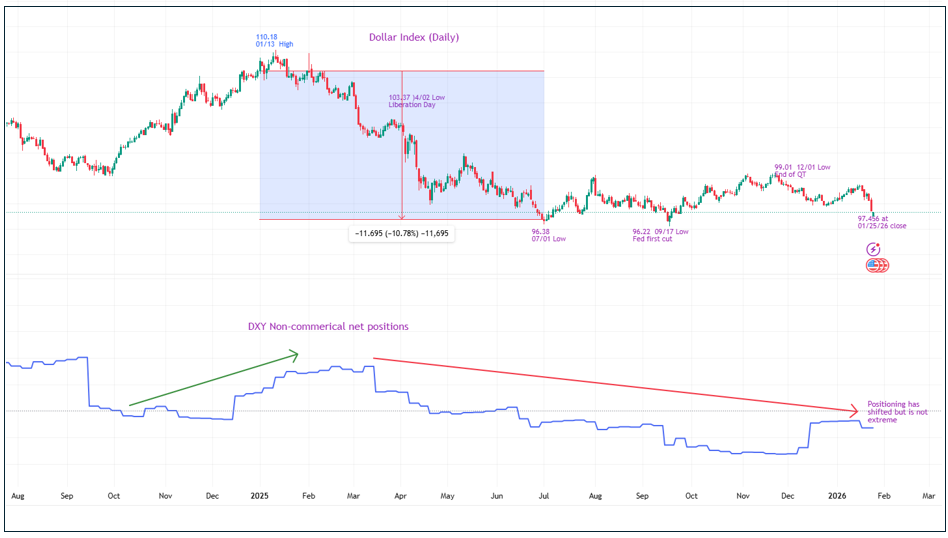
The dollar closed Friday at 97.45 on the DXY. I expect an 8-10% decline from here over the next several months - not a crash, but the continuation of a regime shift that began a year ago. This isn’t a contrarian call anymore; it’s about recognizing what the market has been telling us and understanding why the path of least resistance remains lower.
Why This Matters Now
For over four months, analysts have been writing about the dollar rolling over. It hasn’t happened in dramatic fashion because we’ve already had the dramatic move - DXY fell 10.8% in the first half of 2025, the worst first-half performance in over fifty years. What we’ve seen since June is consolidation, not reversal.
The question isn’t whether the dollar can weaken. It already has.
But the more pertinent question is whether that weakness is structural or cyclical, and whether current levels around 97-98 represent a new range or just a waystation to lower levels. I’m in the latter camp. Price action matters, but it’s the underlying dynamics that tell you whether you’re early, on time, or late. Right now, the catalysts that drove the initial decline remain in place. Some have intensified. None have reversed.
If you traded through the Plaza Accord unwind or watched the dollar’s decline from 2002-2008, the current setup should feel familiar. This isn’t about calling a top or picking a bottom. It’s about recognizing when the structural supports underneath a currency have shifted and positioning accordingly before the consensus catches up.
Historical Context: We’ve Been Here Before
The DXY hit 110.18 in early January 2025. By June, it had fallen to the mid-90s.
That’s not noise. That’s repricing.
To understand why, you need to step back and look at what drove the dollar to those levels in the first place. From 2022 through 2024, we had aggressive Fed tightening while other central banks lagged, US growth outperformance - the “no landing” narrative - and risk aversion episodes where the dollar still functioned as the safe haven. By early 2025, the dollar’s real effective exchange rate was near 1985 levels - the year of the Plaza Accord, when the G5 countries coordinated to deliberately weaken the dollar because it had become destabilizing.
We didn’t need a new Plaza Accord this time. The market did it for us.
The dollar fell 10.7% in the first half of 2025, then spent the second half consolidating in the high-90s. Traders look at that consolidation and ask: Is this the new range, or is this a pause before the next leg down?
Positioning tells you something. CFTC data shows speculators have been net short the dollar since June, though that positioning has moderated from extremes. Asset managers flipped net short for the first time since October. EUR net longs among large speculators are at 18-month highs. The massive outperformance of European stocks in 2025 (in dollar terms) speaks to that clearly. SO, this isn’t a crowded short - it’s a market that’s stopped fighting the trend.
Valuation tells you more. Even after a 10%+ decline, the dollar remains expensive on most medium-term models. Goldman’s DEER framework shows overvaluation. Real effective exchange rate measures put us well above historical averages. The market has repriced some of the excess, but not all of it.
Here’s what matters: The forces that drove that initial decline haven’t exhausted themselves. In fact, several have accelerated.
Catalyst 1: Fiscal Deterioration and the Debt Premium
Let’s start with the uncomfortable truth: The US fiscal position is worse than the consensus acknowledges, and the market is beginning to price that in.
The FY2025 deficit came in at $1.8 trillion. Not a surprise - we’ve been running deficits in that range. What’s changed is the trajectory and the market’s willingness to finance it at the old price.
Total public debt hit $38.04 trillion as of early November, up $2.17 trillion year-over-year.
The “One Big Beautiful Bill Act” adds another $4.1 trillion to the tab over time. Yes, tariff revenue brings in money - projections suggest around $4 trillion over the next decade - but calling that an offset is like saying you’re fixing your household budget by taking a second job while simultaneously buying a vacation home. The net effect is still deeply negative.
The bond market has noticed. Moody’s downgraded US sovereign debt in 2025. That’s not just a rating agency playing catch-up - it’s confirmation of what the market already knew. More telling: We’re seeing rising term premiums on long-dated Treasuries even as the Fed cuts rates. That shouldn’t happen in a normal easing cycle. It happens when investors demand more compensation for duration risk, and in this case, that risk is fiscal.
There’s a specific example worth noting: A Danish pension fund announced it was exiting its Treasury positions. One pension fund doesn’t move markets. But it’s directionally important because it signals a shift in the psychology of foreign holders. For decades, foreign investors treated Treasuries as the risk-free asset they could own with minimal hedging costs. As that calculus changes - as they start to worry about both the fiscal trajectory and the currency risk - you get a slow-motion reallocation that shows up as persistent selling pressure.
This matters for the dollar because of the scale.
The US received $5.5 trillion of portfolio inflows from just before COVID to the present - roughly 18% of 2025 GDP. That capital came in because of the yield advantage, the growth story, and the assumption of institutional stability. All three of those pillars are now being questioned.
I’ve traded through enough cycles to know that fiscal concerns don’t move currencies in a straight line. They create a bias. They make it harder for the dollar to rally on good news and easier for it to sell off on bad news. That’s the regime we’re in.
Catalyst 2: The Tariff Paradox
The textbook theory is simple: Tariffs should strengthen your currency. You’re shifting demand toward domestic goods, reducing imports, improving the trade balance. The currency should appreciate to facilitate that adjustment.
The market didn’t read the textbook.
Liberation Day - April 2, 2025 - provided the natural experiment. The administration announced sweeping tariffs. The dollar fell 1.7% that day. Treasury and equity prices collapsed initially, then recovered. The dollar stayed weak.
If you’ve traded FX for any length of time, you know that’s not how tariff announcements are supposed to work. In 2018-2019, when tariffs were implemented, the dollar strengthened. What changed?
Retaliation changed the game.
When tariffs are unilateral, you get the textbook effect. When they’re met with retaliation and threats of escalation, you get a different dynamic entirely. The market stops pricing the trade policy shift and starts pricing the uncertainty and the erosion of institutional credibility.
There’s a deeper structural issue: If tariffs successfully reduce imports - and the data through Q2-Q3 2025 showed real imports down more than 7% from trend - you’re reducing the supply of dollars to the global system. Fewer imports mean fewer dollars circulating internationally. That might sound like it should strengthen the currency, but it doesn’t work that way when you’re the reserve currency. Reduced dollar availability doesn’t create scarcity value - it creates concerns about dollar-based financing and trade settlement.
We’re also seeing evidence that surplus countries - Taiwan, Singapore, others - are being encouraged to allow their currencies to appreciate as part of trade negotiations. That’s a reversal of decades of dollar recycling, where these countries exported to the US, earned dollars, and recycled them back into Treasuries. If that flow reverses or even moderates, it’s structurally dollar-negative.
The tariff story isn’t over. The Supreme Court is reviewing whether the IEEPA tariffs were lawful. If they rule against the administration, you get $130-140 billion returned to importers and a modest fiscal hit. More importantly, you get headline risk and policy uncertainty as the administration tries to rebuild the tariff wall through other mechanisms.
Either way - tariffs stay or tariffs go - the uncertainty persists.
Bottom line: The tariff policy has created a structural headwind for the dollar rather than the tailwind everyone expected. That’s not changing anytime soon.
Catalyst 3: Policy Uncertainty and Institutional Credibility
The government shutdown that lasted from October through mid-November 2025 provided a stark example of how policy dysfunction translates into currency risk.
During the shutdown, the dollar paradoxically strengthened - climbing from the high-97s to touch 100.40 - as data releases stopped and uncertainty about economic conditions created a defensive bid. But when the government reopened in mid-November, the dollar fell sharply. By early January 2026, DXY had gapped down to the mid-98s, erasing the entire shutdown rally.
What drove that reversal? The backlog of economic data showing weaker-than-expected employment. The confirmation that the shutdown had disrupted growth. And most importantly, the market’s realization that the dysfunction itself - the willingness to shut down the government for six weeks - was a red flag about institutional stability.
Then, in mid-January, came the escalation. The Trump administration opened a criminal investigation into Fed Chair Powell. Within hours, the “Sell America” trade accelerated - stocks fell, the dollar weakened, and gold surged to new highs.
Powell’s term ends in May 2026. That’s four months away.
The market is already starting to game out who comes next and what that means for policy credibility. Will the next Fed chair be someone who maintains independence? Or will we see pressure for more accommodative policy, more willingness to finance fiscal deficits, more tolerance for inflation?
I don’t have the answer to those questions. Nor does anyone else. But uncertainty itself is dollar-negative because it undermines one of the key pillars of dollar strength: the credibility and predictability of US institutions.
This extends beyond the Fed. We’ve seen unpredictable shifts in trade policy. We’ve seen questions about the government’s commitment to traditional alliances. We’ve seen a willingness to use policy tools in ways that depart from historical norms. Each of these individually might be manageable. Collectively, they create an environment where the “certainty premium” that used to accrue to dollar-denominated assets is shrinking.
For foreign investors who park capital in the US, predictability matters as much as returns.
If you’re a European or Asian asset manager, you can tolerate lower yields in exchange for knowing the rules won’t change arbitrarily. When that confidence erodes - even at the margin - you start looking for alternatives.
The practical effect: It’s harder for the dollar to benefit from its traditional safe-haven status when the haven itself is perceived as less stable.
Catalyst 4: Interest Rate Differential Compression
This is the most straightforward catalyst and probably the most powerful over the next 6-12 months.
The Fed cut rates to a 3.50%-3.75% target range at the December meeting. The Summary of Economic Projections showed the median FOMC participant expecting just one more 25bp cut in 2026. The market looked at that, looked at the economic data, and said: You’re going to cut more than that.
Why is the market right?
Because the unemployment rate hit 4.6% in November - the highest level since September 2021. Because job openings are falling. Because the labor market has shifted from tight to balanced to showing signs of slack. Because growth forecasts for 2026 cluster around 1.9-2.0% - modestly below trend - and the risks are skewed to the downside, not the upside.
The Fed is facing the classic lag problem. They’re looking at where the economy was and projecting modest softening. The market is looking at the leading indicators and seeing something weaker.
History suggests the market is usually closer to right in these situations.
The market is pricing 2-3 cuts in 2026, taking the Fed funds rate to around 3.00-3.25% by year-end. That’s a meaningful narrowing of the interest rate differential versus other major economies.
The ECB is likely on hold for much of 2026. German fiscal stimulus has changed the growth outlook for Europe. The BOE is cutting, but gradually, and they’re trying to keep real rates positive. The BOJ continues its normalization path - the only major central bank still in tightening mode.
This isn’t about absolute rate levels. It’s about the change in relative rates.
When the Fed was hiking aggressively from 2022-2023 while others were cautious, the rate differential widened in the dollar’s favor. Now we’re seeing the opposite. Even if US rates stay higher in absolute terms, the trajectory matters more than the level.
Here’s the mechanism: Carry trades unwind. Foreign investors who borrowed in euros or yen to invest in higher-yielding dollar assets start to question whether the carry is worth the currency risk. Corporate treasurers who had been comfortable leaving dollar exposures unhedged start thinking about hedging costs. Pension funds and insurance companies start looking at European and EM bonds that suddenly look more attractive on a risk-adjusted basis.
You can see this in the flow data.
Non-US domiciled ETFs investing in US equities showed average monthly inflows of $10.2 billion in the first half of 2024. That dropped to $5.7 billion in the same period of 2025. European-focused ETFs domiciled in the region received record inflows - $42 billion through July. That’s not a massive shift yet, but the direction is clear.
The interest rate story isn’t finished. It’s ongoing. And every FOMC meeting that moves the Fed closer to neutral while other central banks stand pat is another data point supporting continued dollar weakness.
Catalyst 5: Global Capital Reallocation
There’s a narrative that drove markets from 2022-2024: US exceptionalism.
The US economy was stronger, US companies were more innovative, US markets were more dynamic. If you wanted growth and returns, you overweighted the US.
That narrative is cracking. Not breaking - cracking. The difference matters.
The numbers tell the story. The US received $5.5 trillion of portfolio inflows from pre-COVID through the present. That’s an extraordinary concentration of global capital into a single market. It drove US asset prices higher. It supported the dollar. It created a self-reinforcing loop where strength begat more inflows begat more strength.
When you have positioning that extreme, you don’t need a crisis to reverse it.
You just need the narrative to weaken at the margin. You need investors to stop adding to their overweight and start thinking about rebalancing toward a more neutral position.
We’re seeing the early stages of that. European investors are allocating more to local assets for the first time in years. Asian investors are finding opportunities in their own markets that don’t require taking dollar exposure. Sovereign wealth funds and central banks are diversifying reserve holdings - not away from the dollar entirely, but toward a less concentrated position.
This isn’t panic selling. It’s strategic reallocation.
And strategic reallocation, by its nature, happens slowly. But it’s persistent. You don’t get the dramatic volatility of a crisis, but you get steady, one-way pressure.
The irony is that US assets might continue to perform well even as the dollar weakens. The S&P can grind higher while the DXY grinds lower. In fact, for foreign investors, that’s the ideal scenario - you get equity appreciation in local currency terms enhanced by dollar depreciation. But from a US investor’s perspective, it means international assets offer better total returns when you factor in the currency component.
The key insight: When positioning gets this extreme, mean reversion doesn’t require a catalyst. It just requires the absence of new reasons to extend the positioning further.
And right now, those new reasons are hard to find.
You’re seeing this play out in real time: gold closed 2025 at record highs near $4,332 per ounce after surging more than 60%, with central banks adding roughly 1,000 tonnes to reserves for the third consecutive year - the kind of diversification that happens when confidence in dollar-denominated assets shifts at the margin.
Catalyst 6: Liquidity Dynamics - The Fed’s Balance Sheet Pivot
On December 1, 2025, the Fed formally ended quantitative tightening.
This is a bigger deal than most market commentary acknowledged.
For two and a half years, the Fed withdrew roughly $2.4 trillion from the financial system through QT. That’s a massive liquidity drain. It created a headwind for risk assets and a tailwind for the dollar because tighter financial conditions generally support the currency.
That’s over now.
Not only has QT ended, but the Fed has restarted Treasury bill buybacks to maintain ample reserves in the banking system. This is technically distinct from QE, but the effect is similar: The Fed’s balance sheet starts expanding again, even if modestly at first.
There’s a metric that sophisticated macro traders watch: the Net Liquidity Indicator. It’s calculated as the Fed’s balance sheet minus the Treasury General Account minus the Fed’s reverse repo facility. It’s a proxy for how much liquidity is actually available in the financial system.
The historical relationship is clear.
During COVID (February 2020 through December 2021), net liquidity surged. The dollar weakened consistently through that period. When the Fed launched QT in June 2022, net liquidity fell. The dollar strengthened and then consolidated at elevated levels.
Now we’re at the inflection point where net liquidity is set to rise again. The mechanics are straightforward: Expanding balance sheet adds liquidity. Falling RRP balances (which have been declining) add liquidity. Static or growing TGA is neutral to positive for liquidity.
Why does liquidity matter for the dollar?
Because in a world of ample liquidity, investors have less need to hold dollars for precautionary or funding purposes. They can take more risk. They can invest in higher-beta currencies and assets. The “liquidity premium” that accrued to the dollar during the tightening cycle starts to dissipate.
This isn’t a silver bullet. Liquidity conditions are one factor among many. But they’re a factor that’s shifting from headwind to tailwind for dollar weakness, and that shift is structural, not cyclical.
Conclusion: The Path Forward
Six catalysts. None of them are going away in the next quarter. Several are accelerating.
The fiscal trajectory is set - there’s no political will for consolidation, and the OBBBA ensures deficits stay elevated. The tariff policy has created structural uncertainty that persists regardless of specific trade deals. Policy and institutional questions won’t be resolved until we see who the next Fed chair is and how they navigate the political pressures. Interest rate differentials are compressing as the Fed eases and other central banks hold. Capital reallocation is a multi-year trend that’s just beginning. And liquidity conditions are shifting from tight to neutral to loose.
This is why I’m confident in the 8-10% downside call from current levels.
It’s not about timing a specific catalyst or event. It’s about recognizing that the underlying structure has shifted and the path of least resistance is lower.
DXY at 97.45 isn’t cheap. It’s still elevated relative to long-term averages and most valuation models. A move to 88-90 would represent normalization, not overshoot. And given the weight of the catalysts, normalization seems like the baseline rather than the aggressive case.
This won’t be a straight line. We’ll have bounces. We’ll have days or weeks where the dollar catches a bid on risk-off flows or better US data.
But the trend is established, and the forces sustaining it are structural.
What’s Next
In Part 2, I’ll walk through the cross-asset implications of this dollar weakness. How should you think about positioning in equities - US versus international versus emerging markets? What does it mean for credit spreads, both investment grade and high yield? Where are the opportunities in rates markets? Which currency pairs offer the best risk-reward? And what’s the outlook for commodities, particularly gold?
The catalysts are clear. Now we need to translate that macro view into actionable portfolio positioning.
(Stay tuned for Part 2: Cross-Asset Implications, coming soon)