

· macrofireside.com · August 27, 2026
On the Kansas City Fed’s 2026 symposium, August 27 to 29, and the key question that is not on the program.
The 2026 Jackson Hole symposium convenes under the banner of financial innovation in payments. The market will attend a different conference. Headline inflation is running twice as volatile as its pre-pandemic norm, the long end of the Treasury curve is probing levels last seen nearly two decades ago, and a first-year Chair with a long paper trail of institutional critique must now defend an anchor the data no longer supports. This note argues that the anchor problem is institutional rather than analytical, that the payments agenda is the anchor question wearing a different set of clothes, and that the long end of the curve, not the keynote, will deliver the verdict.
The program and the conference underneath it
The Federal Reserve Bank of Kansas City convenes its 2026 Economic Policy Symposium at Jackson Lake Lodge from August 27 to 29 under the theme “Financial Innovation: Implications for Payments and Policy.” Roughly one hundred twenty central bankers, academics, and officials will attend, and the Fed Chair delivers the keynote on Friday morning, August 28, at ten o’clock Eastern. It will be Kevin Warsh’s first, fourteen weeks into his chairmanship, after two meetings that held the funds rate at 3.50 to 3.75 percent. This year the calendar gives that speech unusual weight. The September FOMC meets on the 15th and 16th with a fresh Summary of Economic Projections, which makes the Tetons the last major signaling window before the projections print.
Symposium themes are chosen months in advance, and they have a history of colliding with the moment. The 2007 program, “Housing, Housing Finance and Monetary Policy,” was considered dull when it was announced; by the time attendees arrived, the housing market was collapsing into it. Something similar may be under way now. The 2026 program is about how money moves. The conference underneath it is about what money is worth, because the nominal anchor that organized four decades of policy has stopped behaving like an anchor.
The exhibit that inverted the premise
An exhibit circulating widely this month, built on Bureau of Economic Analysis data, makes the point in one small table. From 1990 through 2019, Granger causality tests between core and headline PCE inflation ran in both directions at p-values below 0.001. Core predicted headline, headline predicted core, and the Fed could treat core as the signal and headline as the noise. In the 2020 to 2026 sample the premise fails. Core no longer predicts headline in any statistical sense, with a p-value of 0.675, while headline still predicts core at 0.033. Over the same window the swings in headline PCE inflation, the dispersion of the yearly rate rather than its level, have run nearly twice as wide as they did across the prior three decades.
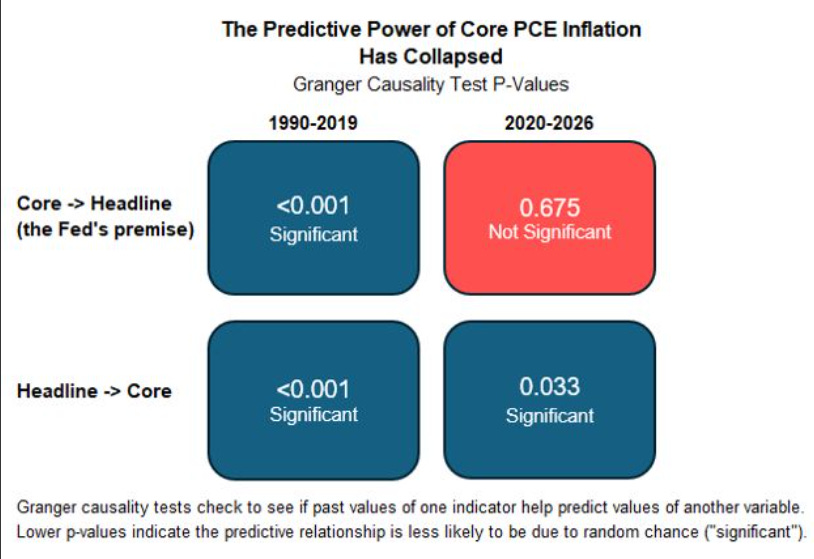
Source: Daleep Singh, PGIM. Reproduced with permission.
The usual caveats apply. Six years is a short window for causality testing, and one regime episode dominates the sample. But the intuition survives the caveats, and the tape agrees with the intuition. What the surviving cell of that exhibit captures is pass-through. Supply shocks that once transited the price level now embed in it, and the entrenchment shows up as headline marching into core rather than core disciplining headline. To me, this is key. For thirty years the institution’s working premise was that it could look through headline because core told it where inflation would settle. That premise has not merely weakened; it has inverted. Shocks now originate where the Fed does not look and travel to where it does.
The candidate explanations are not mysterious. The past five years stacked a pandemic on top of two wars, a step-change in tariffs, recurring shortfalls in food and energy, and a demographic slowdown in labor supply. The old framework treated each disturbance as independent noise that mean-reverted on its own schedule, which is what licensed the instruction to look through it. Recent commentary from the buyside has posed the right question: whether these shocks are independent and mean-reverting, or connected and compounding features of a new geoeconomic regime. If they are connected, each one raising the odds and the persistence of the next, then looking through them is how a central bank falls behind the price level in slow motion.
The latest data reads like one more row of the exhibit. Wednesday’s July report, released the day before the symposium opened, put headline PCE at 3.7 percent, above forecast and unchanged from June, while core came in at 3.3 with the monthly pace at 0.2 percent (actually 0.2445%) against June’s 0.1. The disinflation has stalled with headline 1.7 points above target, and it has stalled from the headline side, which is the inversion doing its work in the current quarter. The labor half of the mandate was squeezed from the other direction back on August 7, when July payrolls printed at minus 23,000 with unemployment at 4.1 percent. A committee that meets in under three weeks with fresh projections to publish will be looking at both facts at once.
The anchor is not an equation
The analytical response is already forming, and it will fill the sessions and the working papers. Rebuild the framework around connected shocks. Refit the reaction function. Choose a better index. Some of that work will be good. It is also aimed at the wrong constraint, because a central bank facing this tape would, in the textbook, restore its anchor the old way: restriction, sustained until expectations give way. This Fed talks restriction and withholds it. July’s meeting produced hawkish language, three dissents, and no hike, which by now is a pattern rather than an event.
The reason is arithmetic before it is doctrine. Federal interest expense crosses a trillion dollars for the fiscal year this month, $963 billion of it booked through July, and compounds at whatever yields the Treasury must pay to roll the stock. Every hundred basis points of restriction is a fiscal event before it is a monetary one, and a Fed that hikes into that wall reprices its sovereign’s solvency math in public, in front of every participant in the Treasury market. No chairman announces fiscal dominance. It announces itself in the gap between hawkish vocabulary and stationary policy, and the market has learned to read the gap.
This is why the anchor problem is institutional rather than analytical. The issue is not only that the Fed’s model of inflation broke, although it did. The issue is that the Fed’s freedom to act on any model is narrower than its vocabulary, and markets price freedom, not vocabulary. The instrument that prices it is the currency, with the long end of the curve as co-signer. The dollar’s behavior against funding currencies, gold’s persistent bid, and a bear steepener that carried the long bond yield to a 5.31% close on August 17, its highest since 2007, are the same trade expressed three ways: a repricing of what a hawkish sentence is worth when the speaker cannot afford the hike.
The levels that matter from here are round ones, I like to think. As ten-year yields approach 5 percent and the long bond approaches 5.5, risk markets that have so far graded this debate as academic will get the memo, because at those yields the arithmetic of equity duration stops negotiating. The tell watch is not the level itself but the official response to it, as we have gathered lately. If the Treasury or the Fed begin to tinker at those levels, through issuance skewed further toward bills, buyback operations dressed as liquidity support, or renewed talk of balance sheet maneuvers, the tinkering is the event. Defending the long end is the confession that the long end needs defending. The Treasury has already supplied the demonstration. On August 19, two days after the long bond’s highest close since 2007, the buyback operations in the 10-to-30-year sectors were at least doubled, and the relief they bought lasted one session. I wrote about that operation at length last Sunday. Record yields, an official response dressed as liquidity support, a one-day rally, resumption: the tell fired a week ahead of the symposium, on schedule and in public. Readers of this publication’s Dollar Ahead series will recognize the sequence; it is that thesis arriving with a receipt.
Payments are where the anchor went
All of which makes the official theme less of a detour than it appears. Financial innovation in payments, in 2026, means stablecoins, tokenized deposits, and tokenized collateral, and each of those instruments is eventually a machine for generating Treasury bill demand. Stablecoin reserves sit in short-dated government paper by statute. Tokenized cash funds settle in bills by construction. Every new rail that scales adds a structural bid at the front of the curve at precisely the moment the sovereign’s issuance calendar needs one. A Treasury that must place historic volumes of its paper and a central bank that must protect its credibility both find the payments agenda convenient, because it manufactures demand for the maturities the government prefers to sell while leaving the long end to price fiscal risk on its own. That is how it seems.
I wrote earlier this month about tokenization as a regulatory and market-structure question. The Jackson Hole framing completes the picture: the dollar’s defense is migrating from price to plumbing. The network moat, the rails on which the world transacts, is being reinforced even as the anchor, the stability of what travels on those rails, erodes. The symposium’s theme is therefore the anchor question wearing new clothes. Who funds the sovereign, in which instrument, at what maturity, and what does the currency cost along the way. A conference about payments, held three weeks before a projections meeting, in the first year of a Chair who cannot hike, is not a technology conference.
The mechanical consequence is a steepener with structure behind it. Bill demand from the payments complex, plus issuance skewed toward bills, starves the long end of sponsorship at the same moment it is being asked to absorb the fiscal risk premium alone. That is not a cyclical trade that mean-reverts when the data softens. It is the funding architecture of the new regime.
A first keynote
Kevin Warsh delivers his first Jackson Hole keynote as Chair, at an institution whose consensus culture he spent years criticizing from outside. His paper trail warned of fiscal and monetary entanglement and of a central bank grown too large in markets and too fond of its own models. The entanglement he warned about is now his operating constraint, and the interesting question is whether he names it. His public method so far is a stated destination with no route: “There is no soft inflation target,” he has said. “There’s only a target, and it’s 2%.” Five internal task forces are reviewing how the institution operates, one of them on communications, with reports due by year-end, and he has withheld the forward guidance his predecessors spent freely. The market has already tested the style once, reading an earlier set of remarks as a lack of resolve and taking long yields to two-decade highs on the interpretation. July’s meeting went 9 to 3, the three dissents coming from regional presidents who wanted a hike.
Three things are worth listening for, none of them the September signal that the headlines will extract regardless. First, whether the speech engages headline inflation at all or retreats to core, because engaging headline concedes the inversion. Second, how financial innovation is framed: as payments efficiency, which would make the theme genuine, or as a source of demand for government paper, which would make it fiscal. Third, whether the long end is defended verbally, because a verbal defense is the same confession as an operational one. The 2025 keynote moved markets by validating cuts; the asymmetry now runs the other way. Hawkish words from this Chair are fully priced. Futures put roughly a 30% chance of a September hike, so the question under the speech is not the timing of cuts but whether the cycle is paused or finished. The available surprises are lopsided. In the hawkish direction, every sentence short of an actual hike is already priced, so only the hike itself would move markets. In the dovish direction the bar is far lower: no action is needed, only language the market can hear as distance from the target.
Three variants are on offer Friday from the Fed Chair, and they map onto the tells. A hawkish package with reassurance attached: firm on the target, a tactical hike left visibly on the table, the balance sheet parked with the task forces, and reserve stability promised, which leaves the Treasury’s long-end operations standing unopposed and would be read by the long end as volatility suppression, risk-positive on the day whatever it means for the anchor on the horizon. A speech of sharp sentences and deferred specifics, every instrument routed to the reviews, which is what the muted price action into the symposium says the market has priced. Or a short, unorthodox performance, stout on inflation and opaque on the metrics, the reaction function and the balance sheet. Nobody prices that third branch highly, and the quiet tape agrees, but it is the branch a book has to respect, because it is the one that would force the market to reprice the institution rather than the meeting.
What it means for the book
The referee for all of it is the long end, and the levels are known in advance. Five percent on tens and five and a half on the long bond are where this debate stops being academic for risk assets, and the market entered the week at 4.72 and 5.26 on tens and the long bond, close enough to read the signs without binoculars, because at those yields equity duration, credit spreads, and the AI capital expenditure complex all mark to the same discount rate at once. Below those levels the symposium is theater with a good backdrop; at them it becomes a margin call.
For positioning, the implications repeat what this publication has argued since spring, now with a date attached. Duration is not the hedge it was in the prior regime, and the structural steepener is a cleaner expression of the anchor problem than any single point on the curve. Dollar strength against funding currencies should be read as repricing rather than health, with the yen cross as the working tell. Gold remains the anchor’s understudy and trades like it. The payments complex and the front of the curve are where official convenience will concentrate; long duration everywhere is where the credibility leak will drain. None of this requires anticipating the keynote. Confirmation before anticipation: the window offers three prints in sequence, the Friday speech, the long end’s close behind it, and the September projections, and the tape’s verdict on the first two will be legible before the third arrives. Jackson Hole will spend three days on how money moves, and the market will spend them deciding what money is worth, which has been the anchor question all along.
Disclaimer
The Macro Fireside is published for informational and educational purposes only. Nothing in this publication constitutes investment advice, a solicitation, or an offer to buy or sell any security, financial instrument, or investment product of any kind. The views expressed are solely those of the author and do not represent the views of any employer, affiliated entity, or counterparty.
All analysis reflects the author’s independent judgment as of the date of publication. Market conditions, data, and regulatory environments change rapidly; no representation is made that any information herein remains current or accurate after the publication date. Past performance of any asset class, strategy, or instrument referenced herein is not indicative of future results.
Readers should conduct their own independent research and due diligence, and consult a qualified financial adviser, attorney, or tax professional before making any investment decision. The author may hold positions in securities or instruments discussed in this publication. Such holdings are subject to change at any time without notice and without obligation to update this publication.
This publication is not directed at, and should not be relied upon by, any person in any jurisdiction where its distribution or use would be contrary to applicable law or regulation. By reading this publication, you acknowledge and agree that the author and The Macro Fireside bear no liability for any investment decisions made in reliance on its contents.
Sources & References
Federal Reserve Bank of Kansas City.
U.S. Bureau of Economic Analysis.
Board of Governors of the Federal Reserve System.
U.S. Department of the Treasury.
PGIM, research commentary.
Bloomberg, Reuters, CNBC, and Euronews.