

The tape: May payrolls +172,000 vs. +85,000 consensus. March revised to +214,000, April to +179,000 — a combined +93,000. Three-month average: 188,000.
The rest: U3 unchanged at 4.3%. Participation 61.8%. Average hourly earnings +0.3% on the month, +3.4% on the year. Workweek 34.3 hours.
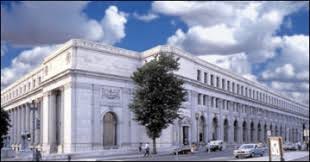
Bureau of Labor Statistics Building, Washington DC. Courtesy: BLS
Payrolls doubled consensus. The trend tripled it.
The Bureau of Labor Statistics reported 172,000 new jobs in May. The Street expected 85,000. On most mornings that gap alone would carry the day. Not this one. March was revised up 29,000 to 214,000. April was revised up 64,000 to 179,000. The revisions add 93,000 jobs to a labor market everyone had agreed was stalling. The three-month average now stands at 188,000.
A month ago, the market believed trend job growth was running near 75,000 a month and fading. This morning the BLS says trend is 188,000 and firming. Same economy. Same workers. Different data. The re-rate I wrote about after the April report — the one the stillness was hiding — just showed up in the official statistics.
June is a lock — to hold. The hike has a date problem.
Markets settled the June question before lunch. As of mid-morning, futures price a 0% chance of a hike at the June 16–17 meeting — 96.7% hold — and just 13% for July. The tightening lives at the back of the calendar: roughly two-thirds odds of at least one hike by the December 9 decision, about 23 to 24 basis points in total. Call it one full hike by year-end, date to be determined. This report hardened that path without touching the near meetings. The bar to revive the dovish case was a print under 50,000, where job growth would slip below labor force growth. The economy delivered more than three times that, plus revisions. The live question is whether a 188,000 trend pulls the hike forward or adds a second behind it. One print cannot answer that. A summer of prints like this one can. Chair Warsh’s Fed has framed the balance of risks around inflation. Nothing in this report challenges that framing.
Wages will not do the arguing for the doves either. Average hourly earnings rose 0.3% in May and 3.4% over the year — in line and unthreatening, consistent with inflation that is sticky rather than spiraling. The wage data argues for patience. The payroll data says the patience can end whenever prices say so.
Read the composition before you extrapolate the headline.
Two categories produced 125,000 of the 172,000. Leisure and hospitality added 70,000 — five times its 14,000 monthly-average over the prior year — with food services and drinking places alone adding 48,000. Local government added 55,000. Health care added 35,000, in line with its run rate. Now look at the cyclical core. Manufacturing added 7,000. Construction added 17,000. Retail shed 1,100. Transportation and warehousing managed 1,000 and remains 92,000 below its February 2025 peak. Information lost 2,000. Professional and business services added 6,000, temporary help up just 1,400. Total private payrolls rose 120,000 against an 86,000 consensus: a beat, but a modest one. The blowout lives in restaurants and county payrolls, not in the industrial economy.
The diffusion index says the same thing more politely. In May, 54.4% of private industries added jobs — barely above the 50 line that separates expansion from contraction, a reading that belongs to a grinding economy. A genuine 188,000-a-month labor market produces breadth. Not concentration as this one does.
The household survey never got the memo.
The unemployment rate held at 4.3% and has not left a 4.3%-to-4.5% band since last July. The number of people who are jobless less than five weeks fell 286,000. The long-term unemployed — 27 weeks and over — now number 2.0 million, up 524,000 over the year, and account for 27.5% of everyone out of work. Teen unemployment reached 14.7%. Translation: companies are not firing, and outside of hospitality and local government they are barely hiring. If you have a job, you keep it. If you lose one, you wait. The low-hire, low-fire regime did not end in May. It got a layer of restaurant hiring on top.
One line in Table B-1 deserves more attention than it will get.
Financial activities shed 22,000 jobs in May and have now lost 107,000 since its May 2025 peak. Insurance carriers cut 11,000. Commercial banks cut roughly 3,000 more. The market spent this week bidding bank stocks higher on the prospect of wider margins from a Fed hike. The banks themselves spent the month cutting staff at the fastest pace of this cycle. Both things can be true for a while. They will not be true forever. I run exposure on both sides of that tension.
The market’s first answer was a shrug. The second was a sorting.
Within ten minutes of the release the two-year yield spiked 12 bp, five-year up seven, gold fell, and the dollar rose — and S&P futures had moved a tenth of a percent. For an hour equities treated a payroll print double the consensus as old news. When regular trading opened, the market knew where the news really belonged. By 10 a.m. the S&P 500 was down 1.1%. The Nasdaq was down more than 2%. The semiconductor index was down 5.6%. And the Dow? Off a quarter of a percent — with financials green and defense bid.
Read those numbers together and the message is precise. This is not a market pricing recession risk from a Fed hike. This is a market repricing duration. The five-year yield is up nine basis points on the day, the ten-year up six, the selloff still led by the front end. Gold is down 2.8% and silver 6.7%, the same real-rate arithmetic that compresses a long-dated earnings multiple compresses a zero-yield metal. The assets falling hardest are the ones whose value sits furthest in the future. The assets holding the bid are the ones that earn more, today, when rates rise. One caution: one-month implied correlation jumped more than 30% off near-record lows this morning. That statistic tells you when sorting risks may become a selloff. It has not become one yet.
What would change my mind.
I came into this report looking for a sub-50,000 print to revive the dovish case. That scenario is dead for at least a month. The burden of proof has flipped: the question is no longer whether the labor market is stalling but whether 188,000 is real. I have doubts about durability. A hiring trend built on restaurants and local government is a trend with a shelf life, and the most recent Challenger tally — 97,000 announced cuts, concentrated in technology — points the other way. Revisions giveth. Revisions can taketh away.
But you position for the tape in front of you, not the one you expected. This tape says: tightening path is confirmed, rates higher from the front end, dollar bid, duration for sale — and the inflation data now carries all the weight! CPI lands Wednesday, June 10. PPI follows Thursday. The Fed decides June 17 with both in hand — a hold, on current pricing, read for the timing of the hike already penciled in. PCE arrives June 25; the June employment report, July 2. Those prints decide when that hike lands, and whether it travels alone. Payrolls just told us the economy can absorb it. This morning’s tape says parts of the market cannot.
Confirmation before anticipation. The labor market confirmed. Now wait for prices.