

TL;DR
In Louisiana v. Callais (6–3), the Supreme Court struck down Louisiana’s second majority-Black congressional district and tightened the standard for future Section 2 (of the Voting Rights Act) challenges. The majority’s principle—that race-conscious districting cannot be a free-standing tool of governance—has a defensible logic. The dissent’s warning—that the new standard makes discrimination too difficult to prove where it most often occurs—also has force. Neither framework is stable. The real gap lies elsewhere: the absence of enforceable limits on partisan line-drawing. The work returns to Congress, the states, and state courts.
The Supreme Court’s April 29 decision in Louisiana v. Callais, decided 6–3, settles one question while reopening a harder one. Justice Samuel Alito, writing for the majority and joined by the Chief Justice and Justices Thomas, Gorsuch, Kavanaugh and Barrett, held that Louisiana’s second majority-Black congressional district was an unconstitutional racial gerrymander because the Voting Rights Act did not require it. Justice Thomas filed a concurrence, joined by Justice Gorsuch, which would have gone further and questioned the constitutionality of Section 2 itself. Justice Elena Kagan, joined by Justices Sotomayor and Jackson, dissented.
The narrow holding is straightforward. The wider consequences for Section 2 are not.
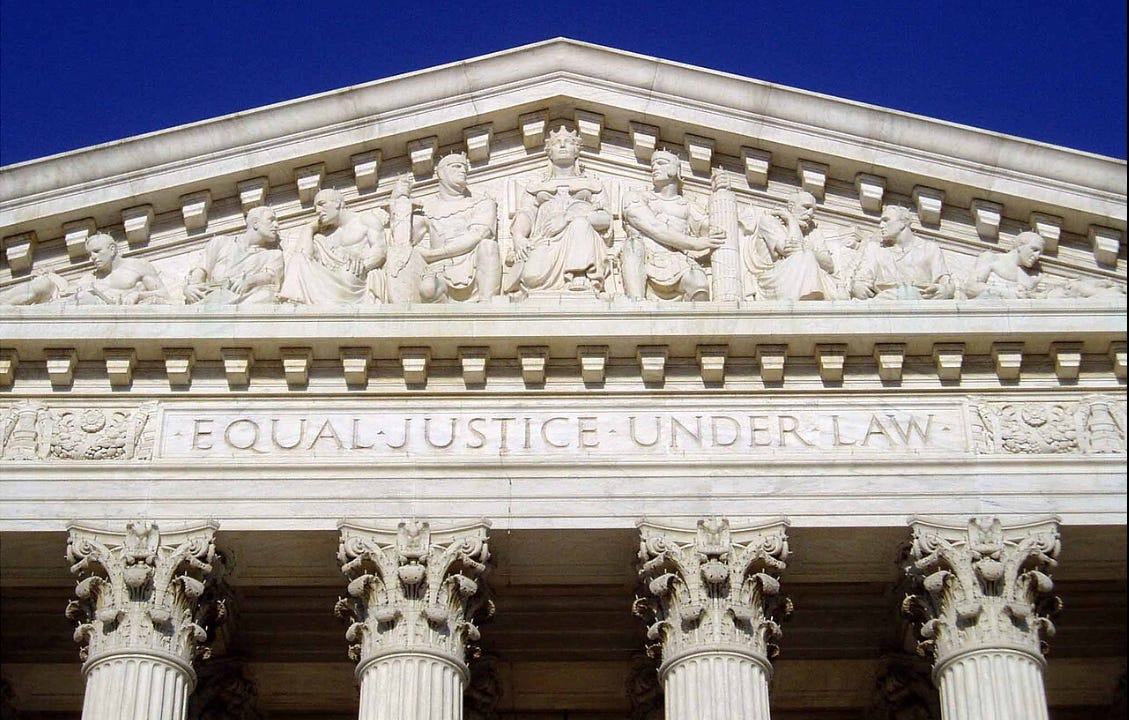
Image: U.S. Supreme Court west pediment
Photo by Matt Wade, CC BY-SA 3.0, via Wikimedia Commons.

For decades, election law has operated inside a contradiction. The Constitution forbids sorting citizens by race except in the narrowest circumstances. Yet Section 2 of the Voting Rights Act—especially after Congress amended it in 1982—has often pushed states in precisely that direction, requiring them to consider race to avoid diluting minority voting power. States have learned to live with that tension. They have not resolved it.
Louisiana’s mapmaking illustrates the problem. After the 2020 census, the state drew a congressional map with one majority-Black district. That map was challenged under Section 2. Facing adverse rulings in lower courts, the legislature adopted a new map with a second majority-Black district. That, in turn, triggered a different lawsuit—this time arguing that the state had gone too far and relied on race in violation of the Equal Protection Clause.
The Supreme Court has now said the second map cannot stand. The majority’s reasoning is straightforward: if federal law did not require Louisiana to create an additional majority-minority district, then the state cannot justify race-based line-drawing by invoking that law. Race-conscious districting may sometimes be permissible as a remedy. It is not a free-standing tool of governance. The Court also tightened the prospective standard, requiring future Section 2 plaintiffs to show intentional discrimination and to disentangle race from politics in environments where the two are closely aligned.
That principle has a defensible logic. A constitutional system committed to equal citizenship cannot indefinitely organize representation around racial categories and still claim that those categories are losing their legal force. At some point, a remedy risks becoming a rule.
But the dissent identifies the danger in the Court’s approach. Congress amended Section 2 because discrimination in voting is rarely overt. Legislatures do not declare racial motives; they operate through proxies—geography, incumbency, partisan advantage. By requiring plaintiffs to disentangle race from politics in jurisdictions where the two overlap, the Court may have created a standard that fails in the very places where minority vote dilution is most likely to occur. Justice Kagan’s warning that the decision renders Section 2 “all but a dead letter” speaks not just to the rejection of this map, but to that tightened evidentiary burden.
That tension is not going away. The prior framework risked making race too central to political representation. The Court’s revised framework risks making discrimination too difficult to prove. Neither offers a stable foundation for the future.
The answer is not to preserve racial mapmaking as a permanent feature of American elections. Nor is it to assume that formally race-neutral rules will reliably produce fair outcomes. The real gap in the current system lies elsewhere: in the absence of clear, enforceable limits on how far legislatures may go in drawing lines for political advantage.
A more durable settlement would shift the focus. Instead of asking courts to calibrate the proper degree of racial consideration in districting, the law should constrain the incentives that make such calibration necessary. National standards for redistricting transparency, compactness and contiguity; independent commissions where feasible; and meaningful constraints on extreme partisan gerrymandering would do more to protect voters—of all backgrounds—than continued reliance on racial line-drawing. After Rucho v. Common Cause (2019), the realistic vehicle for the last of these is state constitutional litigation and state-level structural reform, not federal judicial doctrine—a channel the Court preserved in Moore v. Harper (2023).
The Court has clarified what states may not do. It has not provided a blueprint for what they should do instead. That task now returns to Congress, the states, and state courts, where it belongs.
The Voting Rights Act was designed to secure equal participation in political life. That objective remains intact. The method, after Louisiana v. Callais, is no longer.