

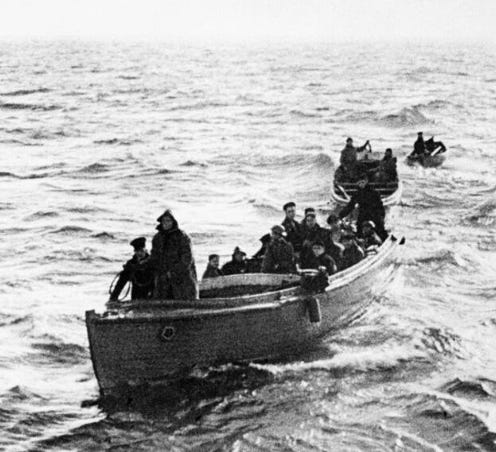
Photo courtesy: Imperial War Museums
TL;DR. Iran wants to draw the United States into a protracted war it cannot sustain politically. The asymmetric costs of escalation — borne heaviest by the Gulf states, Europe, and Asia, but real enough at home — argue for a different posture: reopen the Strait under an internationalized guarantee, accept face-saving terms for Tehran, and go. Regime change has not materialized and does not seem likely. But the other two pillars of the administration’s emerging three-tier order — a consolidated Western Hemisphere and a Europe tethered to American LNG — are advancing on their own. The Iran leg does not need to be forced. It needs to be released.
On 4 June 1940, Churchill rose in the Commons to describe an evacuation, not a victory. “Wars are not won by evacuations,” he told the House. And yet Dunkirk mattered precisely because it preserved the force that would, five years later, win the war. The army came home. The fight continued on terms of Britain’s choosing.
The United States faces its own Dunkirk question in the Persian Gulf.
The Shape of the Quagmire
The facts do not flatter. The February 28 strikes decapitated Iran’s clerical leadership. Iran answered by closing Hormuz and mining its approaches. A ceasefire was negotiated in early April. The Islamabad talks failed on 12 April. A US naval blockade of Iranian ports began the next day. Iran has reimposed its own counter-blockade on commercial traffic. The IRGC has conducted 21 confirmed attacks on merchant ships since hostilities began. Tehran is now collecting tolls on tankers even as few, if any, are prepared to navigate the treacherous waters.
Brent is above $106; WTI near $97. Physical barrels delivered into Asia are changing hands well above the backwardated futures curve. Retail gasoline in the United States is above $4 a gallon. The IMF has cut 2026 global growth to 3.1% from a pre-war 3.3%, and Middle East and North Africa growth to 1.1%, a 2.8-point down revision. Iran’s GDP is set to shrink by 6.1%. UNCTAD projects merchandise trade will slow from 4.7% last year to 1.5–2.5% this year. The Dallas Fed puts potential Q2 drag on global real GDP at 2.9 percentage points annualized if the closure persists. The strait is, in the IEA’s phrase, the site of the largest supply disruption in the history of the oil market.
This is the status quo. Not the worst case. The status quo.
The Asymmetry Cuts Both Ways — But Not Equally
Proponents of holding firm argue time is on America’s side. Iran is bleeding an estimated half a billion dollars a day by the administration’s own account. Its currency has fallen to roughly 1.32 million Rials per US dollar. A near 70% inflation rate confirms dire economic conditions. Oxford Economics estimates the blockade could cut 70% of Iran’s export revenues. The regime is isolated, decapitated, and under pressure the United States can sustain indefinitely from over the horizon.
This is half true, but the half that is not true is the half that matters.
Iran absorbs pain in ways its adversaries cannot. A theocracy of 93 million people, with an established martyrdom narrative and a security apparatus that has survived sanctions since 1979, does not fold on a quarterly earnings cycle. The cost to Iran of another six months is misery; the cost to its neighbors is prohibitive and even regime-threatening. The IMF has cut its outlook for Bahrain, Iraq, Kuwait, and Qatar especially hard; Saudi Arabia’s 2026 forecast is down from 4.5% to 3.1%. Qatar’s North Field damage will take three to five years to repair, we gather. The Gulf Cooperation Council economic model — the quiet triumph of the last forty years — is, as one analysis puts it, in systemic collapse.
Europe and Asia take the direct hit from the price shock — Asia takes roughly 84% of Gulf crude and 83% of Gulf LNG; China, India, Japan, and Korea alone account for close to 70% of those flows. The United States is structurally better insulated but not immune: thirteen American servicemembers are dead, and gasoline above $4 is the kind of number that travels.
The deeper asymmetry is political. Iran’s leadership loses nothing by continuing. Washington’s does. Iran is playing for time. America is paying for it.
The Gulf Safe Haven Is the Real Collateral
As I wrote on 1st March, in “Fire Over the Gulf’s Safe Havens: Dubai, Iran and the Crosshairs,” the unseen loss in this conflict is not a barrel of oil. It is the business model. Dubai, Abu Dhabi, Doha, and Riyadh have spent four decades constructing a peculiar and valuable thing — a zone of predictable calm adjacent to perpetual disorder. It is noteworthy that nearly 90% of the UAE’s population consists of expatriate residents from over 200 countries. The wealth management, tourism, aviation, logistics, and residency industries those cities built are priced against an assumption: safety. That was severely challenged in the first days of the war as Iranian missiles and drones struck Dubai, Abu Dhabi, Manama, Kuwait City, and Doha; the Burj Al Arab was set on fire. Dubai International Airport was damaged by missile strikes. A Kuwaiti tanker was hit at Dubai port. Ten million barrels of oil a day of production capacity has since been taken offline by Gulf producers unable to store or export.
The real damage from this is reputational — the kind that took decades to build and can be lost in weeks. Every additional month of conflict is a month in which expatriate deposits move to Singapore, Zurich, and London; in which insurance and reinsurance rates reset permanently higher. The longer Washington holds position, the more it degrades the very Gulf partners on whom the next forty years of the order depend.
The Three-Tier Order Does Not Require This War
In a recent articulation of where the administration may be headed, Simon Watkins lays out a tripolar design: Western Hemisphere consolidation, a Europe tethered to American LNG, and containment of China through control of Middle East energy chokepoints. A pro-Western Tehran controlling Hormuz and Bab El-Mandeb would have handed Washington roughly 45% of global oil flows and a chokehold on Beijing’s energy security. Iran was the keystone. But that is not on the cards anytime soon.
But the more important point is that the other two pillars do not require the Iran pillar to stand. Europe is already pivoting to American LNG; the EU–US framework, however unrealistic in its headline numbers, marks the direction of travel, and Qatar’s damage has accelerated rather than reversed it. The Western Hemisphere consolidation runs on its own clock. Forcing the Iran outcome does not rescue the Hormuz pillar — it bleeds the budget, political capital, and alliance patience needed to complete the first two.
Strategy is about what you choose not to do. The Iran leg can be released without collapsing the design.
What a Successful Retreat Looks Like
Dunkirk was not a white flag. It was a controlled extraction that allowed the next fight to be fought on better ground. To me, the equivalent here comprises four pieces.
Freedom of navigation: guaranteed and multinational. France, Britain, Germany, and Italy have already proposed a multinational escort mission under the framework of Operation Aspides. Accept it. Internationalizing the guarantee dilutes the bilateral confrontation and makes any future Iranian interference a provocation of Asia and Europe rather than a bilateral test with Washington. It converts a US liability into a shared global responsibility.
Iranian oil flows, under a negotiated cap. Iran is already smuggling out oil. Formalizing a controlled export channel in exchange for verified mine clearance and cessation of tolls costs little and buys the working premise of a settlement.
A face-saving diplomatic architecture. Tehran will not surrender in public. It can compromise in private. A third-party frame — Oman brokered the original ceasefire protocol, and Pakistan hosted the Islamabad round — provides the space. What Washington needs is not Iranian capitulation but verifiable Iranian compliance. Those are different things.
A declared American victory. This is the Churchillian move. The air campaign achieved its narrow military objectives. The Strait will be open. The broader regional order is being rebuilt on American energy terms. All of that is true. Saying so is not spin; it is strategy. The alternative — grinding on with gasoline above $4 and a fraying ceasefire toward an unclear objective — is the quagmire the administration was elected to avoid.
The Better Part of Valor
There is a version of this conflict in which Washington holds firm, Iran cracks, and the keystone snaps into place. It is not impossible. But it is a path with a high and compounding cost, and the cost is borne by the very alliance system the three-tier strategy ultimately depends on.
The better course is the one Churchill found at Dunkirk: preserve the force, claim the deliverance, fight another day — in the knowledge that the day, if Tehran is sensible, may never come. A successful retreat is not the opposite of victory. In conditions of asymmetric cost and diminishing returns, it is the form victory takes.
America should take it.
The Macro Fireside • A Macro Trader’s Read