

A thesis tested is not a thesis broken. Part 2 told you to size for a dollar bounce toward 100–102; it has arrived. What follows is why the structural case outlasts the bounce, and where it leads.
Where Part 2 left off
Part 1 made the case for a multi-year dollar decline. Part 2, in February, mapped it across equities, credit, rates, FX and commodities, and named the single risk that could stand the thesis on its head: a flight to safety if the Iran confrontation became a war. It became a war. From March into May the Strait of Hormuz delivered a genuine energy shock, headline inflation ran to 4.2% by May, and the dollar did what frightened capital makes it do. It rallied. The dollar index pushed back above 100 to around 101, its highest in a year, while the euro slipped from 1.18 toward 1.14. The June interim peace deal has drained the energy premium from the tape, yet the dollar has kept its gains, because the second source of its strength is still running: a Federal Reserve under Kevin Warsh holding at 3.50–3.75% and signaling hikes, with the market now pricing a move by October.
So the uncomfortable part first, because the discipline of this letter is confirmation before anticipation. In the near term, the dollar call has been wrong-footed. Part 2 named this exact outcome — a bounce toward 100–102, to be sized for rather than feared — and here it is. A thesis tested is not a thesis broken, but it keeps the right to continue only if you can say plainly what runs against it, and then show why the structure outlasts the cycle.
The structure is fiscal. The dollar’s strength today rests on a contradiction that cannot hold: a central bank tightening into four-percent-plus inflation to defend its credibility, sitting astride a budget that needs the opposite. To see why that contradiction resolves against the dollar, you have to go down to the engine room and look at the debt.
The king of debt
“I’m the king of debt,” candidate Trump told CBS in 2016. He meant it as a boast, and offered the method: when things sour, you renegotiate—“give you back half.” It is a memorable line, and it describes the one exit a reserve-currency issuer never has to take. That should reassure no one.
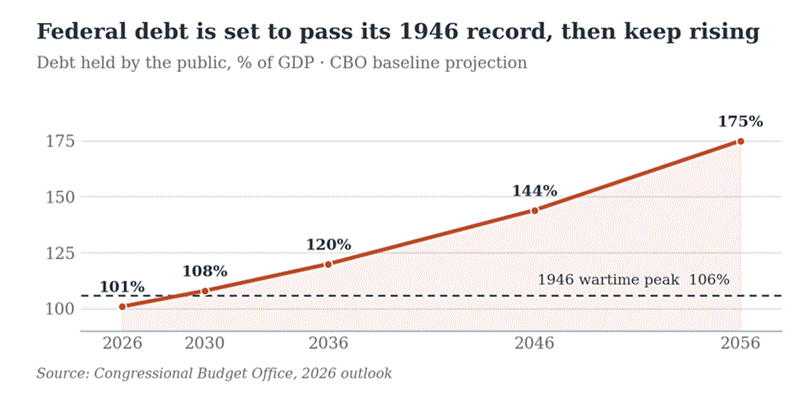
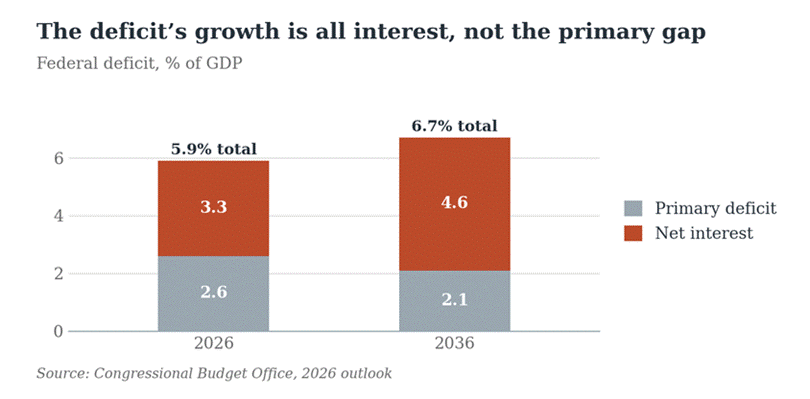
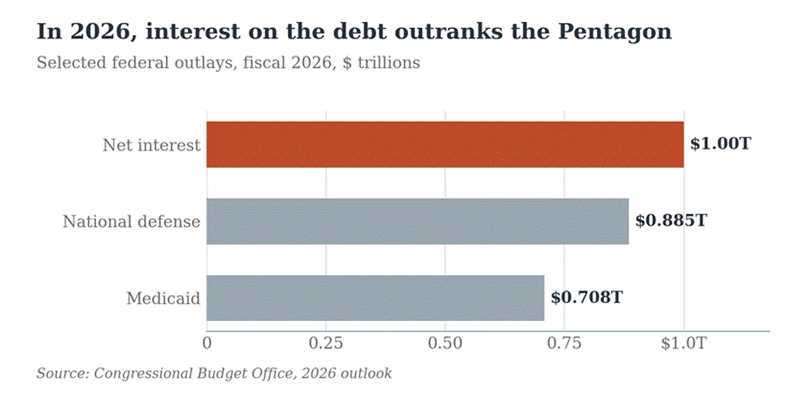
Begin with the stakes, since they aren’t in dispute. Federal debt held by the public sits near 101% of GDP and will pass the 1946 record within a few years, bound for 120% by the mid-2030s. The deficit is running close to 6% of GDP at full employment, with no war and no recession to excuse it. The line that turns a slow problem into a fast one is interest: now above a trillion dollars a year, more than Washington spends on national defense, and on course to double within the decade. The Congressional Budget Office’s latest baseline shows the average interest rate on the debt overtaking the economy’s growth rate around 2031. When r exceeds g, the debt compounds faster than the income that services it. That is the ignition sequence for a spiral, and the accelerant was legislated: the 2025 reconciliation act added roughly $4.7 trillion to projected deficits.
Five doors
Carmen Reinhart and Belén Sbrancia once catalogued how nations have actually shed their debts, as distinct from how they intended to, and counted five doors.
The first is growth. Lift output faster than the cost of the debt and the ratio falls while no one suffers. Today’s version wears an Artificial-Intelligence badge, and the productivity case deserves respect. But no honest forecast lets you outgrow a primary gap this wide, and the capital boom meant to lift productivity is flooding the market with long-dated supply now, years before the output shows up. Growth is necessary. But will it be adequate?
The second is austerity. Spending cuts work, but the spending that bends the curve is the spending no one will touch: Social Security, Medicare and the interest bill itself. Discretionary outlays are a rounding error, and shrinking on their own. The system’s revealed preference, written into law, has been to widen the deficit rather than narrow it. A credible multi-year consolidation perhaps describes some other country.
The third is default, the King’s own answer, and the door that stays bolted. A government that borrows in a currency it prints, and that the world holds as its reserve asset, has no need to stiff its lenders. The one time it toys with the idea, it discovers that the credibility is the franchise. An explicit American default is less a forecast than a contradiction in terms.
That leaves the two doors countries actually use, and both are quiet. The fourth is a burst of inflation: let prices jump and the real value of fixed coupons dissolves. It works once, and only by surprise. Once the lesson is learned the market prices it, which is precisely what a term premium is: the lender demanding payment in advance for the next surprise. Much of that option has already been spent. A 5.2% high-water mark on the 30-year Treasury yield this past May was the receipt.
The fifth is financial repression, the playbook history credits with the postwar miracle. Hold nominal yields below the growth rate, lean on the captive demand of banks, pension funds and insurers, tolerate inflation a notch above target, and let the gap between the two grind down the real value of the debt year after year. Savers earn less than inflation. The burden migrates from the Treasury to the bondholder with no announcement and no ceremony. That is how a debt above 100% of GDP was brought down once before, and it is the likeliest spine of how it comes down again.
The ransom is paid in dollars
The King will not renegotiate the debt, because he will not have to. The realistic path is a blend: a little growth, a long run of negative real returns for anyone who lent long, inflation tolerated half a point hot for years rather than quarters, and fiscal restraint only at the margin. Compound that over a decade and you reach “give you back half,” delivered slowly, deniably, and entirely in the fine print of the instruments themselves. The stealth restructuring is already the base case. The bondholder pays the ransom and hasn’t yet mailed himself the invoice.
This is the dollar story the first two parts of my series have been circling. A debt retired through tolerated inflation and quiet financial repression is a debt retired in the currency’s purchasing power. The bondholder handed back half in real terms and the dollar holder whose claim erodes are the same person. The stealth restructuring and the structural dollar decline are not two theses; they are one mechanism seen from two windows. Which is why the present strength is the cycle, not the trend. The hawkish Fed propping the dollar up today is fighting the very inflation the fiscal arithmetic will eventually require it to tolerate. When that resolves, when financing the debt outranks the last point of inflation, the engine turns back over, and the dollar resumes its slow surrender.
The risk worth pricing is not that slow path but the loss of control over its pace. The gradual version works only if the market grants the time. The danger is the disorderly version arriving first: a buyers’ strike, an auction failure no longer waved off as plumbing, a term premium that gaps rather than drifts. The early signals are already on the tape: recent auctions in which primary dealers swallowed twice their normal share, a 30-year yield that ran to a two-decade high as recently as this spring, and a yield curve straining against a central bank leaning hawkish at the very moment the fiscal arithmetic would prefer the opposite. A Treasury that needs repression and a Federal Reserve that must defend its credibility cannot both prevail. That standoff is the live story, and the day it breaks is the day dollar weakness stops being a drift and becomes the rerating my Part 2 had described.
Sovereign solvency is not an accounting fact but a coordination equilibrium. The debt stays sustainable for exactly as long as everyone believes it is and acts on the belief, which is why these episodes hold for years and then turn without warning. Price coordinates belief; it does not measure truth. The hazard is a shift in the point around which beliefs settle, and shifts like that do not arrive in straight lines.
What it means for the book
The right response is patience, not prediction. The cemetery of macro is replete with investors who were right about this a decade too soon, and the last four months are a reminder that the cycle can run against the structure for longer than a position can comfortably wait. The curve Part 2 wanted steeper has since flattened as the front-end priced hikes; the dollar Part 2 wanted lower has since firmed. Neither changes the destination. The implications, even so, are not complicated. Favor the front end and the belly over a long bond that both the term premium and the repression will punish. Hold the steepener as a structural lean, sized to survive a front-end that stays heavy while the hike is in play. Treat real assets and gold as a literal hedge against a debasement that repays in the unit being debased — the one expression that pays whether the resolution is orderly or not. Keep the structural dollar short rather small and stay patient, sized for an index that can press higher before it turns. Carry cash as an option on better prices, not a position to apologize for.
The King had one thing right: nobody knows debt better than he does. He merely mistook which lever history would hand him. He will not renegotiate the debt. The debt will renegotiate itself — and the terms are already printed in every long bond, and every dollar, you own.
Next — Part 4 closes the series with implementation: the specific trade structures, position sizing, and account-level construction that express this framework across institutional and individual mandates.
Sources & References
Carmen M. Reinhart and M. Belén Sbrancia, “The Liquidation of Government Debt,” IMF Working Paper WP/15/7 (2015); originally NBER Working Paper No. 16893 (2011). Source of the five-channels framework.
Congressional Budget Office, The Budget and Economic Outlook: 2026 to 2036 and The Long-Term Budget Outlook (2026). Deficit, debt, interest and outlay projections, and all chart data.
Federal Reserve Board and Federal Reserve Bank of St. Louis (FRED). Federal-debt, dollar-index and Treasury-yield series.
Disclaimer
The Macro Fireside is published for informational and educational purposes only. Nothing in this publication constitutes investment advice, a solicitation, or an offer to buy or sell any security, financial instrument, or investment product of any kind. The views expressed are solely those of the author and do not represent the views of any employer, affiliated entity, or counterparty.
All analysis reflects the author’s independent judgment as of the date of publication. Market conditions, data, and regulatory environments change rapidly; no representation is made that any information herein remains current or accurate after the publication date. Past performance of any asset class, strategy, or instrument referenced herein is not indicative of future results.
Readers should conduct their own independent research and due diligence, and consult a qualified financial adviser, attorney, or tax professional before making any investment decision. The author may hold positions in securities or instruments discussed in this publication. Such holdings are subject to change at any time without notice and without obligation to update this publication.
This publication is not directed at, and should not be relied upon by, any person in any jurisdiction where its distribution or use would be contrary to applicable law or regulation. By reading this publication, you acknowledge and agree that the author and The Macro Fireside bear no liability for any investment decisions made in reliance on its contents.